 Published by Michael Becker
Last updated on March 24, 2026
•
9 minute read
Picture this: it's a Tuesday morning, your phone is buzzing non-stop, three dashboards are screaming alerts simultaneously, and somewhere in that chaos is the actual problem. But which one? That exact scenario is what drives IT administrators crazy - and it's exactly the problem AIOps was built to fix.
AIOps. The term gets thrown around a lot. Some people hear it and think "another vendor buzzword." Fair enough. But once you understand what's actually behind it, the concept starts to make a lot of sense - especially if you're managing increasingly complex IT infrastructure day in, day out.
Let's Start with the Basics: What Is AIOps?
AIOps stands for Artificial Intelligence for IT Operations. Gartner coined the term, and the core idea is this: combine big data, machine learning, and advanced analytics to make IT operations smarter, faster, and less dependent on constant human intervention.
In practice, what that means is that an AIOps platform ingests data from across your entire IT environment - logs, metrics, events, traces - and uses algorithms to find patterns in all that noise. It correlates events, detects anomalies in real time, identifies root causes, and in many cases can trigger automated remediation before your team even opens a ticket. The goal isn't to replace your IT staff. It's to free them from the time-consuming, repetitive work that bogs them down and keeps them from doing more valuable things.
There are actually different types of AIOps approaches. Some platforms are domain-specific, focused on a particular area like network performance or application performance monitoring. Others are domain-agnostic, pulling in data from across the entire IT landscape - network, cloud, applications, security operations, and beyond. The right choice depends heavily on the complexity of your environment and how mature your observability practices already are.
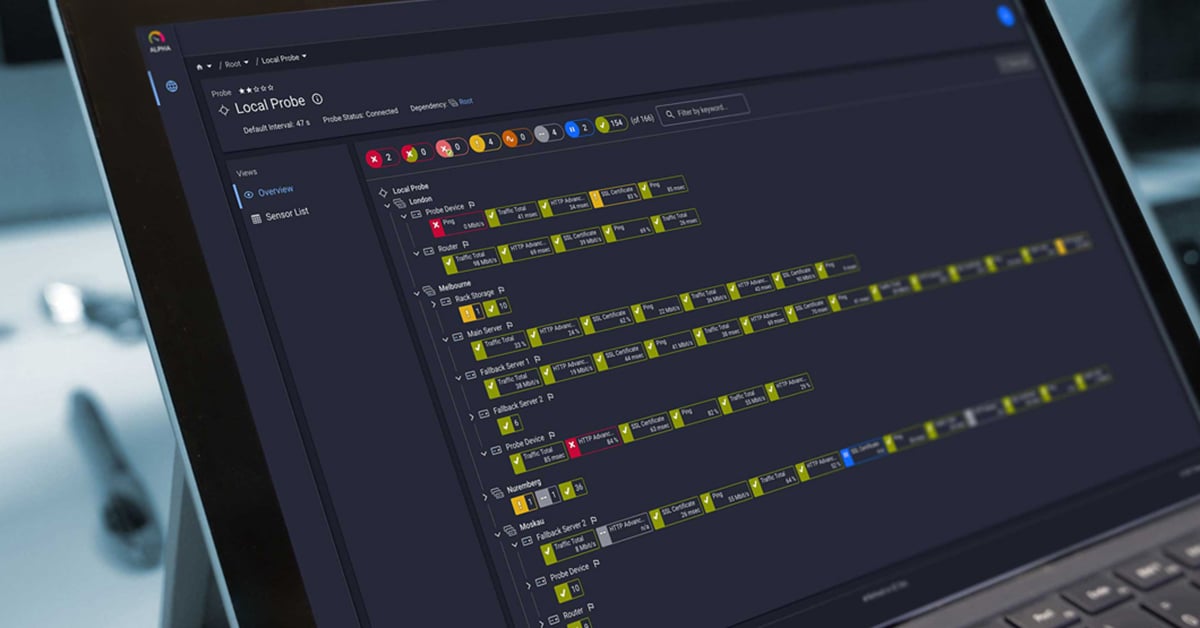
Before AIOps can work its magic, you need solid visibility into your IT environment. PRTG gives you exactly that - reliable, comprehensive monitoring as the foundation for smarter IT operations.
Download PRTG for free and see what full visibility looks like.

The Real Problem: Too Much Data, Too Little Signal
Here's something nobody talks about enough. The challenge in modern IT operations management isn't that you don't have enough information. It's the opposite. You have too much.
Today's IT environments - hybrid cloud, multicloud, microservices, cloud-native applications - generate enormous volumes of operational data every second. All of that data flows through separate pipelines, gets stored in separate systems, and ends up in silos that don't talk to each other. When something breaks, your operations teams have to manually piece together what happened across a dozen different monitoring tools. Meanwhile, mean time to resolution (MTTR) climbs, customer experience takes a hit, and your IT staff is running on fumes.
AIOps addresses this by doing something deceptively simple: it aggregates data from all those disconnected data sources into a single, coherent picture. That aggregation - combined with intelligent event correlation and anomaly detection - is what makes the difference between "we think something's wrong somewhere" and "here's exactly what happened and why."
How Does AIOps Actually Work?
Okay, let's get a bit more concrete. Because "AI makes IT better" is not exactly an actionable insight.
An AIOps platform typically works in a few distinct stages. First, it ingests operational data from across your IT systems - via APIs, log collectors, monitoring agents, cloud integrations. We're talking about massive datasets, sometimes millions of events per day. The platform then uses machine learning algorithms to analyze historical data and build a model of what normal looks like for your specific environment and workloads.
From there, it gets interesting. The system watches for deviations - things that don't fit the established pattern. Anomaly detection kicks in. Related events are correlated automatically. Dependencies between services are mapped. Root cause analysis points your team in the right direction instead of leaving them to guess.
In more mature AIOps solutions, this goes further: automated workflows kick off remediation steps without waiting for human intervention. Incidents get resolved faster. Some incidents get resolved before users ever notice them.
For SRE and DevOS teams, this kind of intelligent automation fundamentally changes the incident response lifecycle. Runbooks that once required manual execution get orchestrated automatically. Troubleshooting time drops. And the team can actually focus on reliability engineering rather than constant firefighting.
AIOps Use Cases That Actually Matter
Theory is nice. But where does AIOps actually show up in real-world IT operations? Let me give you some concrete examples.
Incident management is the obvious one. When a service starts degrading, AIOps correlates the relevant events - a spike in database latency, an overloaded microservice, a misconfigured API endpoint - and surfaces the likely root cause in seconds. Incident resolution goes from hours to minutes. That's a direct improvement to MTTR and a direct benefit to the business services running on top of your infrastructure.
Predictive analytics is where AIOps really earns its keep, though. By analyzing historical data and trends in your metrics, an AIOps platform can identify signals of impending failure before anything breaks. That's not reactive monitoring anymore - that's proactive prevention. For IT teams responsible for systems that can't afford downtime, this is a game-changer.
Then there's alert fatigue. Honestly, this might be the most underrated AIOps use case. In a large IT environment, you can easily receive thousands of alerts per day. Most of them are noise. AIOps tools use intelligent filtering - sometimes incorporating natural language processing and even generative AI capabilities - to surface only the actionable insights that actually require attention. Your team stops wading through irrelevant notifications and starts focusing on what matters.
And in multicloud environments specifically, AIOps provides the observability that's otherwise nearly impossible to achieve manually. When your workloads are spread across AWS, Azure, and on-prem systems, and your applications talk to each other through dozens of interdependencies - having a domain-agnostic platform that pulls it all together isn't a luxury anymore. It's how you stay in control.
AIOps Needs a Solid Monitoring Foundation - And That's Where PRTG Comes In
Let's be straightforward about something: PRTG is not an AIOps platform. It doesn't use machine learning to correlate events across your entire IT landscape, and it won't automatically perform root cause analysis across distributed systems. That's not what it's designed to do - and it's important to say that clearly rather than pretend otherwise.
What PRTG does offer is a feature called Unusual Detection. This uses statistical methods to identify outliers in historical time series data. It's not machine learning in the AIOps sense - there are no individual per-sensor models, no dynamic thresholds per metric, no automated root cause analysis. But it does give your IT teams a useful signal when something in your environment starts behaving differently than usual.
This approach to real-time anomaly detection and IT infrastructure monitoring is exactly what AIOps promises - and PRTG supports it in a way that doesn't require a six-month implementation project. Users have reported catching security threats, potential DDoS attacks, and early signs of hardware failure simply because PRTG spotted the anomaly before it escalated into a full-blown incident. That's the kind of outcome that matters.
The Key Benefits of AIOps - Honestly
Look, AIOps isn't magic. Implementation takes thought, and not every platform lives up to the marketing. But the core benefits of AIOps are real:
🎯 Significantly reduced MTTR and faster incident response
🎯 Better observability across complex, multicloud and hybrid cloud environments
🎯 Smarter decision-making based on real-time insights and predictive analytics
🎯 Less alert fatigue for IT staff, and more time for strategic initiatives
🎯 Lower operational costs through intelligent automation and streamlined workflows
The digital transformation projects that leadership keeps talking about? They depend on IT operations being reliable, scalable, and efficient. AIOps is how you make that happen without burning out your team in the process.
Where to Go from Here
AIOps isn't just for hyperscalers anymore. Organizations of all sizes are realizing that the sheer scale of modern IT environments - the data volumes, the dependencies, the distributed architectures - simply can't be managed effectively with purely manual approaches and static threshold-based monitoring tools.
If you're thinking about where to start, the answer is almost always: better visibility first. Understand what's happening in your IT environment before you try to automate it. Get the performance monitoring foundation right. Then build from there.
Good monitoring is where every AIOps journey starts. PRTG gives you full visibility into your IT environment - reliable, straightforward, and ready to scale with your infrastructure. Try PRTG free of charge and build the monitoring foundation your IT operations deserve.



 You there!