 Published by Michael Becker
Last updated on March 09, 2026
•
8 minute read
You're sitting in a post-incident review. The outage lasted 47 minutes; three enterprise customers are asking questions, and someone from management just forwarded a contract - highlighted in yellow - showing a 99.9% uptime guarantee. Now the room goes quiet and everyone looks at you. In moments like these, two acronyms tend to come up fast: SLA and SLO. Everyone suddenly has an opinion on who's responsible and what was promised.

But honestly - do you actually know the real difference between the two? And more importantly, do you know which one should be guiding your team's actions right now? Let's break it down.
What Is a Service Level Agreement (SLA)?
A service level agreement is exactly what it sounds like: a formal, legally binding contract between a service provider and a customer. It defines the expected level of service - things like uptime guarantees, response time targets, and resolution time commitments. Miss those targets, and there are real consequences. We're talking financial penalties, escalation clauses, sometimes even contract termination.
SLAs aren't just an IT thing. They involve stakeholders from across the organization - sales, legal teams, management. Once signed, they're binding. An SLA breach isn't just a bad day at the office. It can damage customer satisfaction in ways that take months to recover from - and that's before you even factor in the financial penalties.
A typical SLA might commit to things like:
- 99.9% uptime per month (which translates to roughly 8.7 hours of allowed downtime per year)
- A maximum response time of 4 hours for critical incidents
- A resolution time of 8 hours for high-priority outages
These figures get negotiated, agreed upon, signed - and then someone has to actually make sure they're delivered.
What Is a Service Level Objective (SLO)?
Here's where things get more interesting for you as an IT professional. A service level objective is an internal target. No contract, no legal teams, no customer signatures. It's the goal your engineering team sets for itself to make sure you're actually delivering on what the SLA promises.
Let's say your SLA commits to 99.9% uptime. Your team might set an internal SLO of 99.95% - a slightly tighter target, giving you a buffer before you're in dangerous territory. That buffer has a name: an error budget. You're essentially saying: "We can afford this much failure before we start breaking our promises to customers."
This concept comes straight from site reliability engineering (SRE) - a discipline that originated at Google and is now widely adopted across DevOps teams. The idea is simple but powerful: instead of chasing 100% perfection (which is unrealistic and expensive), you define acceptable limits and use them to guide day-to-day engineering decisions. If you've burned through your error budget, you stop shipping new features and focus on stability. If it's healthy, you push forward.
👉 Want to know immediately when your systems are drifting toward SLO violations? Download PRTG for free and start monitoring your service performance today.
SLIs - The Measurement Layer Underneath Everything
You really can't talk about SLOs without mentioning SLIs. A service level indicator is the actual metric you're measuring - the raw data that tells you how your IT service is really performing. Think of it as the foundation everything else is built on.
Typical SLIs include latency, uptime, error rates, and response time. The hierarchy works like this: SLIs are what you measure, SLOs are the targets you set based on those measurable metrics, and SLAs are the contractual commitments that your SLOs are designed to protect. Miss your SLO consistently, and you'll eventually drift into SLA breach territory. And nobody wants that conversation with a customer.
SLA vs. SLO - The Key Differences
So, what's the actual difference when you put them side by side? The most fundamental distinction is who they're for. An SLA is external - it lives between you and your customers, and it involves legal teams and contract negotiations. An SLO is internal - it's a tool for your engineering team and product managers to use in day-to-day decision-making. One is a contract. The other is a compass.
Second: consequences. SLA breaches can trigger financial penalties and long-term damage to customer experience. Missing an internal SLO is a warning sign - an early indicator that you're heading toward trouble. It's your window to course-correct before the real damage is done.
Third: flexibility. SLOs can be adjusted as your systems evolve, as you learn more about your dependencies, or as your business goals shift. SLAs, on the other hand, require renegotiation - and that usually means uncomfortable conversations with legal teams and account managers. Not fun.
Some teams also publish SLOs externally via status pages, especially cloud service providers who want to be transparent about system performance. That's becoming increasingly common - and customers appreciate it.
Why Both Matter for Modern IT Operations
Here's the thing: you can't treat SLAs and SLOs in isolation. They're part of the same end-to-end system. Your SLOs inform your SLA commitments. Your SLIs feed your SLOs. And when outages hit, the data from all three needs to be in front of your team immediately.
This is where observability and incident management become critical. DevOps and SRE teams with real-time visibility into their performance metrics are the ones who catch issues before they become SLA breaches. They're the ones who can point to benchmarks and say: "Here's exactly what happened, here's the impact on user experience, and here's what we did about it." That kind of transparency builds customer trust in a way that no template or marketing promise ever could.
Automation plays a huge role here too. Nobody wants to manually check dashboards all night. Modern IT teams rely on automated alerting to get notified the moment an SLO metric drifts outside expected ranges. That's the difference between proactive and reactive IT - and ultimately the difference between protecting user satisfaction and explaining SLA breaches after the fact. Incident response becomes faster, incident management becomes more structured, and your engineering team can optimize workflows instead of firefighting.
How PRTG Helps You Stay on Top of Your SLOs and SLAs
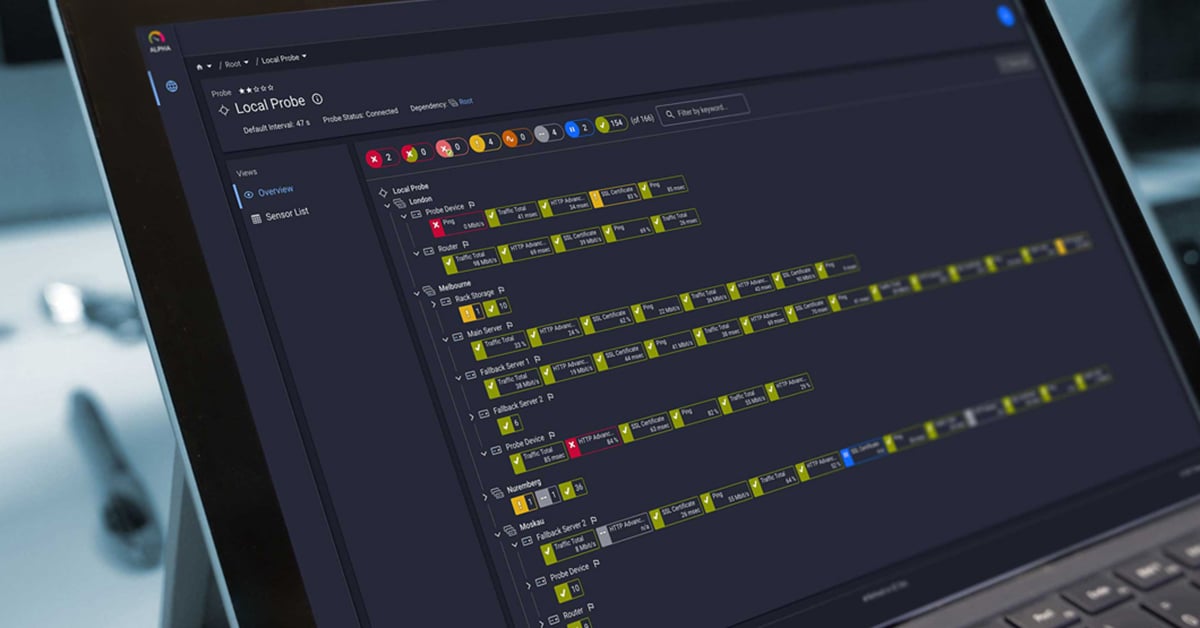
This is where PRTG comes in. PRTG is a comprehensive monitoring solution that gives your team real-time visibility into all the metrics that matter for your SLOs and SLAs. Whether it's response time, latency, uptime, or error rates - PRTG tracks them continuously and alerts you the moment something looks off.
With PRTG, you can set up SLA monitoring that maps directly to your contractual commitments. Automated reports, customizable dashboards, and alerting workflows mean your engineering team always knows where things stand. No more scrambling to pull data together after an outage. No more SLA breaches that better observability could have prevented.
PRTG also supports uptime monitoring and availability monitoring - two of the most fundamental SLIs in almost every SLA. And with built-in response time monitoring, you'll always know whether your services are meeting the performance metrics your customers expect. For teams that take incident response seriously, PRTG integrates alert notifications directly into your existing incident management workflows - so when something goes wrong, the relevant data is already there.
Your SLOs are only as good as your ability to measure and track them. PRTG makes that possible - without unnecessary complexity.
And if you need to go one step further - for example, to provide stakeholders with detailed, scheduled SLA compliance reports - PRTG SLA Reporter extension has you covered. It automatically generates up-to-the-minute SLA reports based on historical PRTG monitoring data, maps dedicated sensors directly to your SLA definitions, and even sends compliance reports straight to your stakeholders via email. Root cause analysis, maintenance windows, customizable report templates - it's all there.
👉 Download PRTG for free and find out how easy it is to keep your services within SLO and protect your SLA commitments.
Keeping the Promises You Make
SLAs and SLOs aren't just bureaucratic paperwork or abstract engineering concepts. They define how reliable your IT services actually are - for your customers, for your team, and for your business goals. Understanding the difference, and building the right processes around both, is what separates teams that simply react to problems from those that proactively maintain service reliability.
If you haven't yet defined clear SLOs for your critical services, now is a good time to start. And if you don't have the monitoring in place to track them - well, now you know where to begin.


 You there!