 Published by Nina Wooten
Last updated on April 14, 2026
•
8 minute read
Let me paint you a picture. It's Monday morning, 8:47 AM. Your colleagues are trickling into the office, grabbing their coffee, opening their laptops. And then the calls start. "The ERP system is down." "I can't access my orders." "Nothing's working." You stare at your screen and think: when did this actually start? And more importantly - why didn't I know sooner?
If that scenario sounds familiar, you're not alone. ERP systems are the backbone of modern businesses. They handle supply chain logistics, procurement, human resources, inventory management, financial reporting - basically everything that keeps a company running. And when they go down, everything goes down with them. The impact on profitability can be significant, sometimes within minutes.
The good news? Most ERP outages don't come out of nowhere. There are almost always warning signs. The trick is having the right monitoring tools in place to catch them early.
What Does an ERP System Actually Do?
Okay, quick detour for context - because "ERP system" is one of those terms that gets thrown around constantly without anyone really explaining it.
Enterprise resource planning is essentially a software solution that brings different business functions together under one roof. A single source of truth, if you will. Modern ERP applications - think SAP, Oracle, or Microsoft Dynamics - typically bundle a whole range of modules: finance, human resources, supply chain, procurement, inventory management, CRM, project management. The list goes on.
The whole point of ERP implementation is to streamline workflows, enable smarter decision-making through real-time data, and push automation across business functions. And in theory, that works beautifully. In practice though? These systems are complex. Whether you're running them on-premises, as SaaS, or somewhere in between - complexity brings fragility. And fragility means you need to keep a close eye on things.
ERP downtime isn't just an IT problem - it's a business problem. PRTG gives you real-time visibility into every layer of your ERP environment. Try it free for 30 days. 👉 Download your free trial
Why ERP Disruptions Are So Tricky to Catch
Here's the thing about performance issues in ERP environments: they rarely just happen. They creep in. Response times get a little slower. A database query that used to take half a second now takes two. A server is quietly running low on memory. Nobody notices - until suddenly everyone notices.
By the time your users are calling the helpdesk, you're already in reactive mode. You're chasing the root cause while simultaneously trying to reassure people that yes, you're working on it. Not a fun place to be.
A proactive monitoring approach flips that around. Instead of scrambling after the fact, you spot the bottlenecks early. You fix things before they escalate. And honestly? That's the difference between being seen as the person who keeps the lights on versus the person who gets blamed when they go out.
How PRTG Monitors Your ERP Environment
PRTG covers all the layers that matter. Here's how that works in practice.
1. The Database
The database is, without question, the most critical component of any ERP system. It's where everything lives. If it's struggling, your entire ERP application will feel it - and so will your users.
PRTG offers out-of-the-box sensors, which is a good starting point for most setups. If your ERP runs on a native or proprietary database - which is pretty common, actually - you can use the ADO SQL Sensor or build a custom script. And if neither of those is quite right for your environment, there's always the EXE/Script Advanced sensor as a fallback. Flexible - which is exactly what you need when dealing with the diversity of ERP solutions out there.
2. Underlying Hardware and Virtualization
This one tends to get overlooked. People focus on the ERP application itself and forget that it's sitting on infrastructure that can fail just as easily. A server running out of memory, a misconfigured firewall, a flaky switch - any of these can take down your ERP environment just as effectively as a software bug.
PRTG monitors all of it. Servers of all kinds - physical, virtual, file servers, web servers - as well as networking devices like switches, routers, and firewalls. On-premises or in the cloud, the principle is the same: know what's happening underneath, and you'll be much faster at pinpointing where a problem actually started.
3. The Business Processes
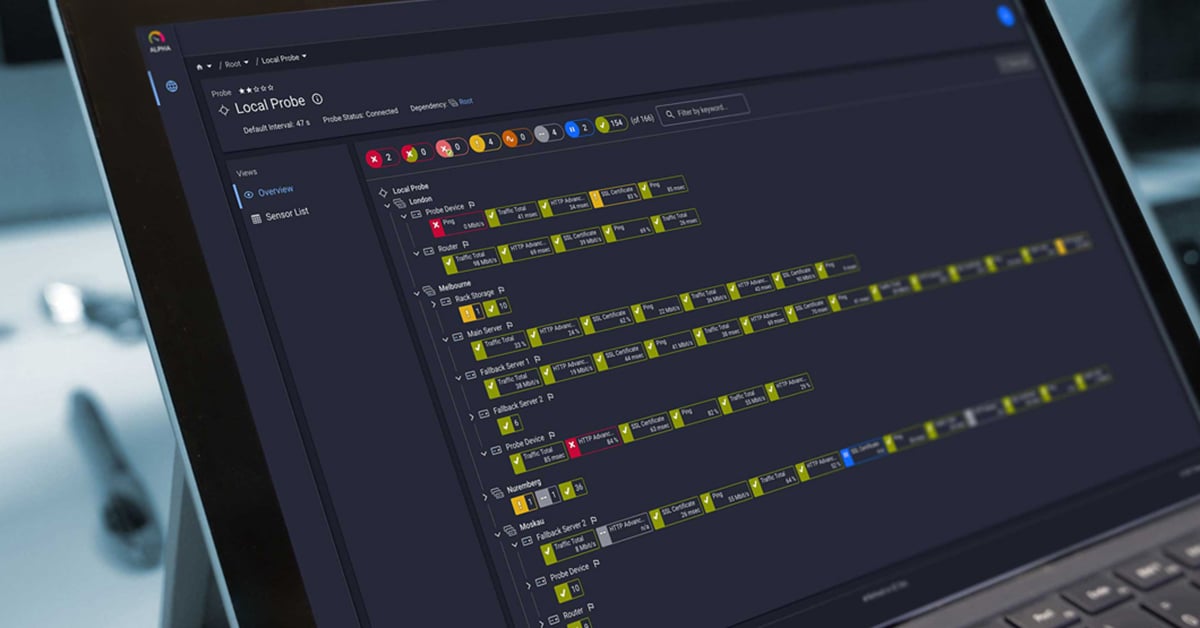
This is arguably the most powerful feature for ERP monitoring specifically. PRTG has a dedicated Business Process sensor that lets you model your entire ERP environment as a single, aggregated health status. One view. Green, yellow, or red.
We actually use this at Paessler for our own ERP setup - which, when you think about it, is a pretty good sign that it works.
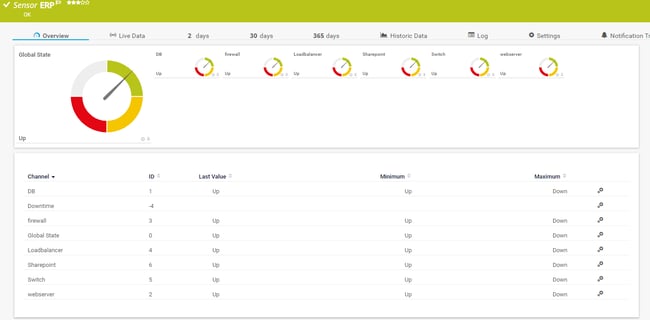
You can pull in whole groups, individual devices, or single sensors. In our own configuration, we included the webserver, firewall, load balancer, switch, database, and SharePoint. The result is one clean dashboard that tells you instantly whether something needs your attention. Curious about how the sensor actually calculates that aggregated state? This knowledge base article walks you through it.
4. Dedicated SAP Sensors
SAP is one of the biggest ERP systems in the world, and monitoring it properly is a discipline in itself. Standard infrastructure checks won't cut it - you need visibility into SAP-specific metrics and KPIs, not just whether the server is up.
Our partner Scansor has built dedicated SAP sensors designed to work directly with PRTG. They integrate into your existing monitoring environment and give you deep, SAP-specific insights - from system availability to performance bottlenecks within individual modules. There's a 30-day trial available, so you can see whether it fits your business needs before making any decisions. More details are on our SAP monitoring page.
Dashboards, KPIs, and Real-Time Data - All in One Place
One thing IT administrators consistently tell us: they don't want more tools. They want fewer tools that do more. PRTG is built around that idea.
You get customizable dashboards that surface the metrics and KPIs that actually matter to your team. Real-time data on response times, availability, resource usage - all in one place, without having to jump between five different systems. And because PRTG scales well, it doesn't matter whether you're running a lean on-premises setup or a distributed ERP environment spread across multiple locations. It grows with you.
That single source of truth feeling? That's what good ERP monitoring should feel like.
Your ERP system keeps your business running. Make sure you know what's happening inside it. Download your free PRTG trial and take control of your ERP monitoring today.
FAQs
✔️ Can PRTG monitor cloud-based ERP solutions? Yes - PRTG works with both on-premises and cloud-based ERP environments, including SaaS deployments. Availability, response times, and performance metrics are all covered regardless of where your ERP is hosted.
✔️ Does PRTG have native SAP sensors? Not natively, no. But Paessler partner Scansor offers dedicated SAP sensors that plug directly into PRTG. You'll find all the details on the SAP monitoring page.
✔️ What happens when PRTG spots a performance issue? You get an alert - via email, SMS, push notification, or whatever channel works best for you - before the problem escalates. That's the whole point of proactive monitoring: you find out first, not last.


 You there!